

Small Trout Runs
By Al Raychard
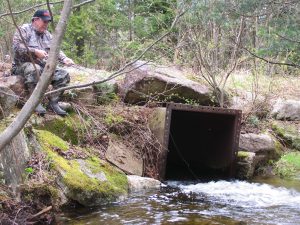
When I was a kid there was a small brook that cut through the property of my childhood home. Until I got my driving license and could explore more distant fishing holes, I spent a lot of time drowning worms in its tea-colored pools. It’s where I cut my teeth as an angler, where I learned to “read” the water as they say, that habit of sitting or standing a few minutes and observing before actually wetting a line and pinpoint the likely spots in a stream where trout are apt to find food, oxygen and safety. It’s something I habitually still do today. I look, recognize and then plan my approach rather jumping in and attacking. It is also where I developed a love for small trout runs and a deep appreciation for what they bring to the early season fishing experience.
There is no denying that the primary reason for fishing these small habitats is to catch trout. In a lot of cases most are too small to have ever seen a stocking trout and are inhabited by native brookies that, despite their diminutive proportions, are as spectacular in color. Even as a kid I was captivated by their coloration and years later when I traveled to the remote reaches of Labrador, Quebec and other brook trout strongholds and caught examples measured in pounds rather than inches it was not just their size but their beauty that I appreciated most. It is what made brook trout my favorite of all freshwater fish as a kid and keeps them there even today. There are much larger and more powerful fish that put on a more demanding and impressive visual display once hooked, but when it comes to colorful aesthetics I can think of none that can compare to brook trout, whatever their size.
The Hooking
And, as much as I enjoy hooking and challenging big fish on a fly rod, anglers drawn to our smallest trout habitats each spring know full well and accept the fact the chances are slim, perhaps even nonexistent, of catching any wall hangers. If you’re lucky the odd 10-incher might be found in the deeper pockets and pools and riffles, but 6-to-8-inch specimens that barely fall within the legal limit are closer to the norm. But size doesn’t really matter. My first fishing outfit as a kid was an inexpensive fiberglass rod of unknown make equipped with an even more inexpensive Zebco spin casting reel that my dad purchased as a package at the local hardware store. I still use something similar today because the combo is easy to maneuver among brush-invested banks and other tight quarters. On similar light gear there is little chance of working up a sweat, but even the smallest brook trout offer a scrappy tussle that can be appreciated.
Catching Trout
But personally, catching trout is not the only reason our smallest waterways call me back each spring. Most fishermen prefer bigger water and theoretically bigger fish. Whether that theory is true or not ,or whether their hopes come true I can’t say, but our brooks and smallest streams draw far less attention, a good many hardly none and there are few outdoor places that are as peaceful and quiet, where you can simply sit back and enjoy the place and moment. And if you listen, there is a symphony of sounds to be heard, an array of birds in the emerging foliage, a gentle breeze in the tree tops, of moving water as it slides past rocks or drops over small cascades into pools and riffles below. The sounds are often supple, but if you listen they can be deafening after a long, hard cooped up winter.
Every angler is different and each has his preferred places to wet a line. I have many but our small trout runs are definitely high on my list. With spring now in full swing I hope you have or find yours.
For more articles about hunting, fishing and the great outdoors be sure to subscribe to the Northwoods Sporting Journal.