

Mastering the Turkey Hunt
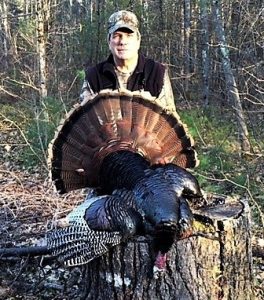
By Stu Bristol
One of my early wild turkey hunting mentors, Ben Rogers Lee warned me, “It’s not good enough to just sound like a wild turkey. You must become one.” From that day forward I adopted the slogan, “Turkey hunters are play actors; the turkey woods their stage.” Secondly, he repeated, “Turkeys will teach you something every time you hunt. You may become successful, but you will never master the sport.”
Back in 1969 I was working as a Vermont State Game Warden when I helped release the first viable restoration of wild turkeys in over 100 years. The biologist, Bill Drake warned all of us around New England that should this restoration become successful we would have a major problem on our hands.
Generations of hunters throughout New England grew up hunting deer, bear, upland game and waterfowl. Not until 1973 were hunters afforded the opportunity to hunt wild turkeys here in the Northeast.
We turned to southern turkey hunters and product manufacturers for advice, and it was like a gold rush. Game call makers and product manufacturers rushed in to offer products and advice. Penns Woods products introduced me to Ben Rogers Lee, D.D. Adams, Neil Cost and more. These legendary southern wild turkey hunters taught New Englanders the ins and outs of wild turkey hunting and, in turn, we became mentors for the masses of deer, bear and upland game hunters.
Wild Turkey Federation
About that same time an outdoor writer from Virginia, Tom Rogers, came to New England searching to increase membership in his newly formed National Wild Turkey Federation.
Half a century later thousands of New Englanders have become at least moderately proficient in sport. While it may seem like an easy task to harvest a wild turkey due largely to the turkeys seemingly lack fear of human predators, hunters new to the sport will find very quickly that it is not.
After half a century of hunting wild turkeys, what advice can I give to new and veteran hunters that will make them more successful? Just as in any sport the basics are the foundation of hunting turkeys.
At this point I caution hunters new and old not to get caught up in the marketing schemes. While others may disagree with me, I feel that buying $200 decoys and $20 per round TSS shotshells won’t make you a better hunter. Basic skills and understanding the lifestyle and habits of your prey will.
First, understand that wild turkeys have excellent eyesight, even better than whitetails and humans. They can run up to thirty miles per hour, fly fifty miles per hour and have the ability to land on a single branch.
With those seemingly super qualities in mind the most critical attribute is the wild turkey’s ability to interpret what they see and react to dangers. Their instinct is to run at first sight or sound that could be interpreted as danger then fly if the danger becomes evident. I have seen turkeys spook and run at the drop of an acorn. That’s how sensitive their instincts are.
How do hunters overcome these obstacles? First, learn their vocabulary. While turkeys have more than 200 vocalizations hunters can get by with understanding six to twelve of them. In today’s world of modern communication there are plenty of sources for hunters to learn vocalizations and how to imitate them accurately.
Next, understand that springtime is the period of time when wild turkeys breed and, like deer, that’s when they are most vulnerable to play-acting hunters.
By now even novice hunters understand that the primary communication for springtime gobblers is the hen mating calls. Any of the calling devices can accurately imitate yelps, clucks, purrs and other vocalizations. Again, drawing from fifty years of chasing these super birds, you don’t need a $100 dollar turkey call. A simple box call, slate or even a mouth diaphragm will suffice. Trumpets, wingbones and tubes are a bit more challenging to operate but fun to explore.
One drawback to operating calls is the urge to sound great. Most hunters call way too much and that’s a turn off for big toms. Too many hunters simply love to hear themselves sound like turkeys. Listen to live birds before the season and you will understand that too much communication with hens or other members of the flock will draw predators.
Once a gobbler hears your hen imitation he knows exactly where you are. To put it rudely, “SHUT UP!” It is natural for the hen to come running to the gobbler and excessive hen calls will cause the tom to hang up and wait for you to come to him.
Instead, it is important to remind yourself that you are a play actor. What would a hen sound like in this situation. Rake leaves with your hands, shuffle your feet and use small feeding purrs and soft clucks. You really need to play “hard to get.”
Mum’s the Word
Sometimes, if you are lucky enough to find a tom that hasn’t been with hens for a while to call aggressively and then shut up and the tom will come in on a string. Other times it may take hours before that old tom gets in front of your shotgun barrel.
Another common mistake new or even intermediate hunters make is to get out every morning before sunrise, thinking that is the only time gobblers will answer. Actually, it can be the easiest time to score or the most difficult, especially early in the season.
Just as many boss gobblers are taken mid-morning and even early afternoon. The old boy has bred a harem of hens and goes searching for others.
Final bit of advice for hunters of all stripes; “let wild turkeys teach you how to hunt.” Know that you don’t have to kill every legal bird that comes in range. Many times it’s more educational to let them walk and learn by what just transpired.
And lastly, I repeat the words I have spoken in so many articles and stage shows. “Hunt turkeys for yourself, not to impress others or accumulate conquests.” Don’t fool yourself into thinking you will ever “master” the sport.
For more articles about hunting, fishing and the great outdoors, be sure to subscribe to the Northwoods Sporting Journal.