

Maine Trout Ponds
By Jonah Paris
Maine is dotted with many small trout ponds. These remote waters are protected by dense walls of softwoods. They are places where “crowded” is another party fishing the opposite shore, and where the country, and the trout, still remain wild. The gravel roads might push back in a little further now than they once did, and the brook trout might grow a little smaller than those detailed in the campfire tales of yesteryear, but there remains no better way to spend a spring day.
Local knowledge can go a long way in the success of a pond outing. Before the adventure, one might benefit from knowing which roads in the network are washed out, where the deep ruts are hiding, and where the truck-mangling potholes lurk. Once at the pond, insight into which of the stashed canoes are unlocked, and of those, which leaks the least can be helpful. Similarly, an understanding of any spring holes, inlets, outlets, and food sources will help the angler locate fish. But truthfully, some of the most enjoyable trips lack any real “knowing.” Instead, I often set out to the trout ponds with my fishing gear, a canoe or kayak, a picnic lunch, a spare tire, a full tank of gas, and a DeLorme Atlas and Gazetteer. Occasionally, to my delight, Ashley and Aurora, the beagle, join and we camp for a night or two.
The Forage
Depending on the season, time of day, and primary forage in the pond, still water anglers will work the top or work the bottom. Opportunistic fishermen will bring a pair of 4 – 6 weight outfits – one rod loaded with floating line, and one with sinking line or sink tip. Flies are largely a matter of personal preference. So long as the angler brings precisely the right patterns in precisely the right sizes, they will be all set. Just remember, insulting a Hornberg or Maple Syrup back in town can quickly cause a brawl. Similarly, questioning the effectiveness of a Parachute Adams, Royal Wulff, or Pale Evening Dun will get you into deep trouble.
Ponds can be deceiving. They may appear devoid of life until a large cloud moves overhead, a storm rolls through the hills, or, perhaps the most exciting and frustrating event that can bless and curse the trout angler, an insect hatch materializes. The first hour of daylight on a trout pond, and especially the last hour, can provide the fisherman with a truly magical experience.
But after that evening hour wanes, the paddle back to the shore can be tough. Luckily, you know which pine silhouette denotes the launch area. The sun has long since set, and your “last cast” turned into a couple dozen. Despite having plucked the bushiest size 8 White Wulff from your box an hour ago, it is too dark to see it. All you can do is hope that the fly is still tied on, and that you did not discreetly donate it to an overhanging branch twenty casts ago. But rest assured, you will soon discover three elaborate wind knots that you have managed to tie in your leader.
Bats are now swooping eerily close overhead, but splashes of feeding trout have only become more frequent. Since humans first walked the earth, fish have had a way of ensuring that prompt, responsible individuals are routinely and unapologetically late in their return home. You stop paddling just long enough to hear an eruption in the weed bed over your right shoulder. “How big was that trout?” you wonder. And even though you know better, you still torture yourself with a guess. Everyone knows giants haunt the shallows after hours.
Fish for Breakfast
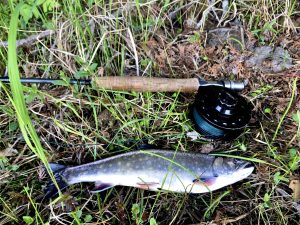
You drag the canoe back to its original resting place against the leaning cedar, and flip it back over; this is the unspoken rule of the backwoods. The boat was locked at one point, but the rusted chain has grown deep into the flesh of the old tree, and the lock is likely buried under a few inches of soil somewhere nearby. You unload your fishing gear, your paddle, and your trout. You released all but one, a fine ten-incher. The flanks of the squaretail are strikingly dark, the hallmark of a fish taken from tannin-rich water. Fresh trout and eggs in the morning will be more than breakfast; it will be an experience. As the moon rises higher above the pines, a loon cries out from the far side of the pond, and despite the spring chill in the air, you feel a sudden wave of warmth. This is Maine at its finest.
For more articles about hunting, fishing and the great outdoors be sure to subscribe to the Northwoods Sporting Journal.