
Growing Bigger Bucks
By V. Paul Reynolds
The Maine Department of Fish and Wildlife (DIF&W) recently issued a press release encouraging fall deer hunters to pass on the young bucks thus enabling our deer population to comprise larger and older bucks. To this end, hunters no longer need to pass on a doe while holding out for that trophy buck. It is now legal to harvest both a buck and a doe.
So wildlife officials are suggesting that you take your doe first for the freezer, and then hold out for that buck of your dreams.
Here is an excerpt from that press release:
“Let’s look at some of the benefits of allowing younger bucks to grow for another year by looking at antler form and body mass at different ages. Looking at three recent years of biological data from deer in Maine, our average yearling buck sported between 3 and 4 antler points, and our average 2-year-old buck had 6 to 7 points. There’s a lot of growth between a buck’s 1st and 2nd birthdays! While the most significant antler development takes place between the yearling and 2-year-old age classes, it’s not until around year 5 that our Maine bucks begin to approach their peak antler growth potential.
A yearling buck weighed an average of 122.5 pounds dressed weight, and a 2-year-old weighed 148.6 pounds. Body mass continues to increase with age, and around years 5 or 6, our Maine bucks near their peak body mass with an average body weight approaching 200 pounds dressed weight.”
Of course, November deer, especially wily old bucks, rarely stand still long enough for a thorough age analysis, but there are telltale indices for younger bucks.
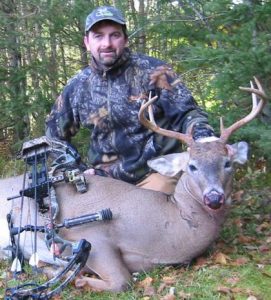
“A yearling buck will tend to resemble an adult doe aside from the antlers. Most yearling bucks have 3-4 antler points, but in some areas may grow up to a basket rack with 8 or more points. A yearling will have a relatively long, thin face and long legs relative to its body size with a tapered waist.
By 2 years old, the neck and body appear more stout and well-muscled, and the face begins to appear more boxy. The rack still tends to be a bit thin but will begin to resemble its final form. The legs will appear more proportional to the body.
By 3 years old, the body frame continues to fill out, and you may see a more squared face and figure and a slightly sagging belly. The rack may be quite a bit thicker, and the neck may appear wider than the face.
By 4 years and beyond, you may begin to notice some swaying in the back, a very thick neck during the rut, a sagging belly, and a very muscular and blocky appearance.”
So, in a real sense, the state wildlife managers are putting the ball in your court, if you are a deer hunter. You want larger racked and heavier bodied deer? Let the young bucks have a pass- a few more seasons to grow.
For more articles about hunting, fishing and the great outdoors, be sure to subscribe to the Northwoods Sporting Journal.