

Accessing Stripers
By Al Raychard
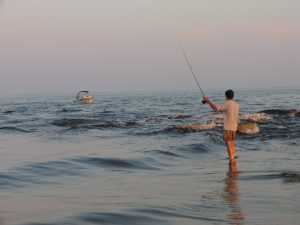
If you want to fish for striped bass this season there are a couple things to keep in mind. As with all types of fishing, be it freshwater or saltwater and whether fishing quiet back bays and small tidal creeks and estuaries with a fly rod and flies or hitting the beach with surfcasting rods and metal spoons, topwater plus or bait, it helps to have the right tackle. But that is a topic for another day.
Just as important is finding a spot to actually cast a line especially from about Penobscot Bay down to Kittery, the traditional hot stretch along the Maine coast for striper activity. Approximately 95-percent of Maine land is privately owned and along the immediate coastline what isn’t privately owned is controlled or owned by municipalities or the state. Despite that, and considering if you include all the indentations, Maine has more coast line than California. You would think there would be plenty of places where the public could wet a line for striped bass. In truth there are.
The Maine Department of Marine Resources has done a decent job of listing and describing more than four dozen saltwater boat launch and shoreline fishing sites from South Berwick, Eliot and Kittery to Ellsworth and Calais on their web site. It can be viewed at www.maine.gov/dmr/fisheries/recreational/anglers-guide/where-to-fish.
Some time well spent exploring will reveal any number of other land-based fishing locations, but keep in mind it’s summer, the height of the tourist season and visitors from away, as well as many resident Mainers, head for the beaches, bays, jetties and piers. Expect crowds everywhere you go. That is if you can find a place to park, which can be the biggest challenge of all.
Beach Access
Many of our coastal state parks like Crescent Beach in Cape Elizabeth, Popham Beach in Phippsburg at the mouth of the Kennebec, Ferry Beach in Saco and Reid State Park in Georgetown offer access to beaches, tidal creeks, estuaries, bays and other places to fish. Access is free for Maine residents age 65 and over and at $3-to-$6 for residents and just $4-to-$8 for non-resident state park day use passes may be one of the best deals available. Passes are available at most state parks and at www.mainestateparkpass.com.
Most coastal communities have at least one and sometimes several public areas with access to a stretch of beach, jetty, pier or other coastal destination where you can park and fish.
Most town and city locations are clearly posted and require town or city parking permits, generally from mid-June through to around Labor Day. Permits are generally available from town halls, local police or parks and recreation departments, in some cases on line. Some municipal areas are equipped with kiosks where you slip in a credit or debit card and pay for the season or by the hour or day, but again parking spaces are limited, available on a first-come-first serve basis and they fill up quickly.
But it’s well worth exploring the various municipal areas along the coast and getting familiar with any rules that might be posted. While parking permits are the general rule and will cost you some municipalities are generous enough to allow free parking during certain hours of the day, usually before 7 or 8 a.m. before the swimmers and sun worshippers arrive and after 5 or 6 p.m. when most have exited the beach. That is a good thing to know because these before and after hours, if available, are generally the best times of day to fish for striped bass when the tides are right.
Pockets
There are still pockets along the coast that offer free parking, although the number of parking spaces are generally very limited. Parsons Beach in Kennebunk is one of our favorite places to fish. It is located at the mouth of the Mousam and is a great spot for stripers when the tide is right, but only a half dozen legal parking spaces are available along the heavily posed access road. Timber Point in Biddeford is another favorite spot. It offers access to the mouth of the Little River and Goosefare Bay but only there’s only room for two or three parked vehicles. When fishing these two areas and others like them, we typically make an effort to arrive very early or late in the day hoping to find a parking space, even if it means waiting patiently for the tide to change and offer the best or desired conditions.
And keep in mind, striped bass are usually in Maine waters until sometime well into September or October. You may have to pick your days due to changing weather and wind conditions, but many parking restrictions and fee requirements are off-season by mid-September or Labor Day. Along with early and late in the day, one of the best times to fish for stripers is at night when the beaches are empty, parking is generally less of a problem and bass can be found relatively close to shore and in other areas not often found during the day.
For more articles about hunting, fishing and the great outdoors, be sure to subscribe to the Northwoods Sporting Journal.